

Investment Insights
After months of efforts, Zhong Ou (“we”), qualified as a QDII, eventually launched its long-awaited first QDII portfolio (a mandate) in mid-August this year. Upon discussions, we have ultimately decided to focus the investment of mandate on overseas bonds, primarily on Chinese dollar bonds. In addition, the mandate will also target some overseas bonds from other regions. This investment arrangement has been made according to our investment philosophy reiterated in the previous quarterly publications, i.e., reducing the volatility of portfolios through investing in a diverse range of assets to seek long-term and stable investment returns. Considering the great challenges faced by the world’s economies and a changing geopolitical landscape, we are convinced that the only way to achieve positive results for portfolios is to reasonably diversify the portfolios.
The launch and investment of the mandate have coincided with the troubled times of the domestic real estate industry. Following the bond default of China Fortune Land Development Co., Ltd. and the risk events of China Aoyuan Group Limited and Yuzhou Group Holdings Company Limited in the first quarter of 2021, China Huarong Asset Management Co., Ltd. received a downgrade in its rating from international rating agencies in early April after announcing the delayed release of its 2020 operating results and changes in its reorganization plan; since June, there have been reports about the failure of China Evergrande Group to repay its commercial papers as they become due, resulting in a significant price drop in its existing dollar bonds and a big negative impact on China’s high-yield real estate sector as a whole.
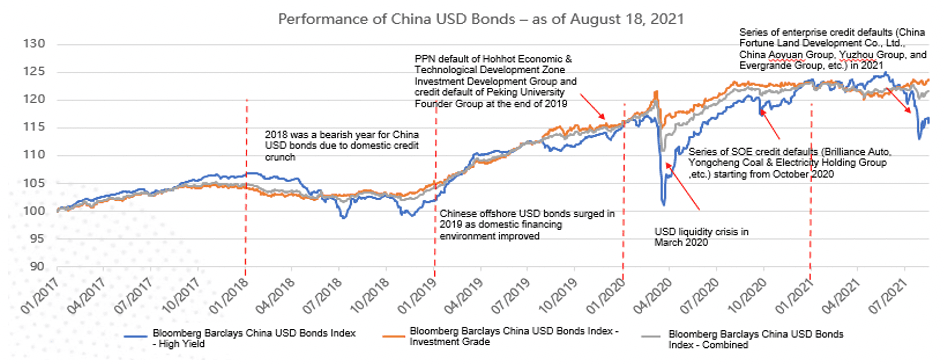
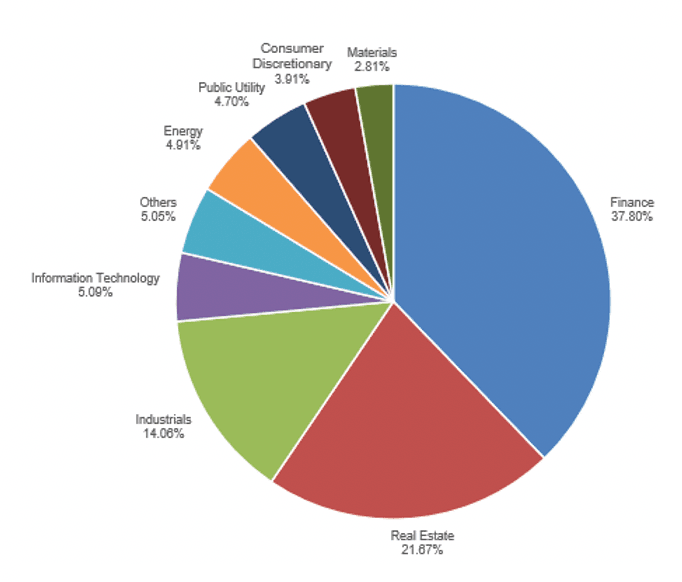
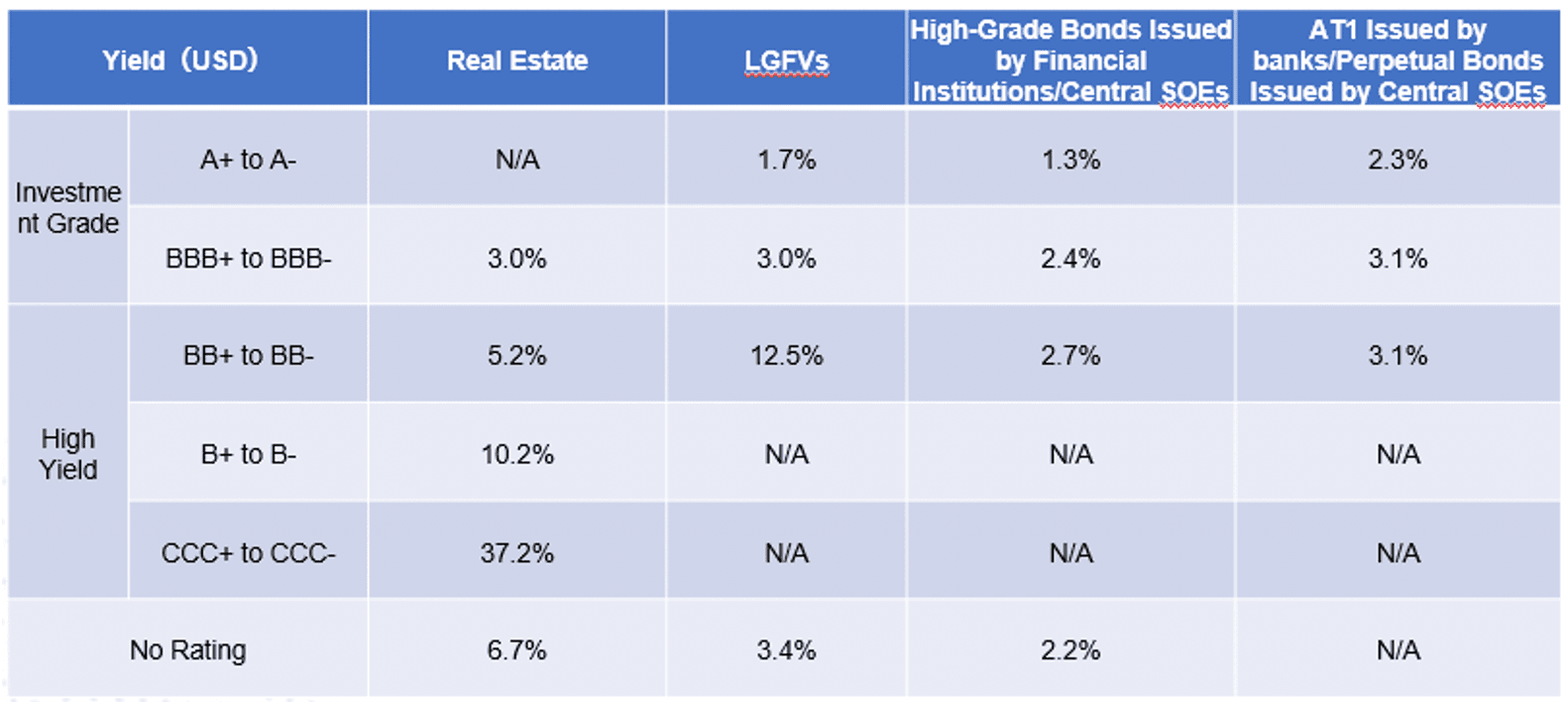
The worsening financing environment for domestic real estate developers is undoubtedly bound to adversely affect the movements and sentiments of the Chinese dollar bond market. The negative impact of the real estate industry, however, is relatively controllable when we are making investment. The main reason is that we have been holding a cautious and conservative attitude toward the real estate sector as early as the beginning of this year. On the other hand, the crisis of the real estate sector has exposed the potential risks of real estate companies and triggered overseas market adjustments. As a result, the better performing ones of these companies have been put in the spotlight, bringing many good opportunities to buy into the undervalued companies. In addition, it should be noted that the Chinese dollar bonds are not all issued by real estate developers. According to Wind, as of the end of August 2021, the outstanding Chinese dollar bonds amounted to USD938.7 billion, of which USD203.3 billion or around 22% was from the real estate industry, 37.8% from the financial industry, and 14.06% from the industrial industry. While ensuring the stable and higher returns of our portfolio, we may consider investing in the Chinese dollar bonds of good performing issuers from other industries.
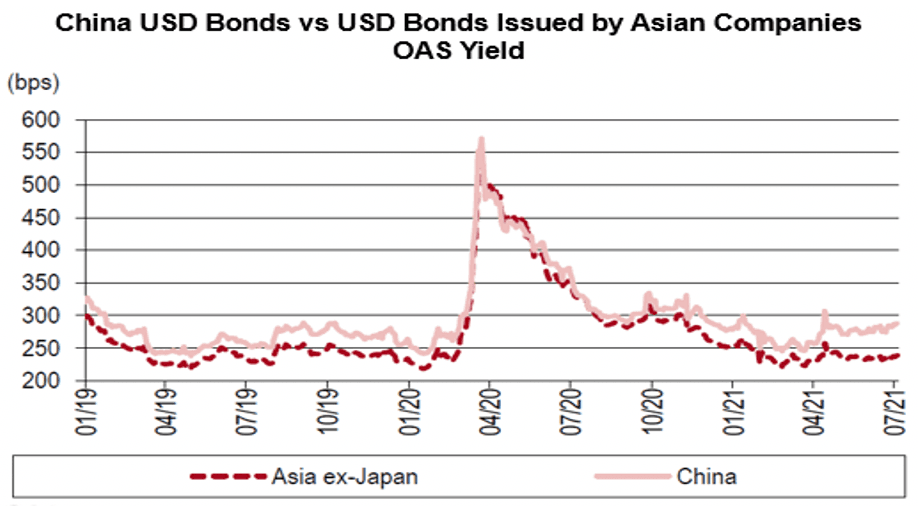
As a new QDII, we intend to participate step by step in the large overseas market by fully upgrading our internal systems and greatly expanding our research on overseas bonds. At present, we plan to start the overseas bond investment strategy by predominantly investing in Chinese dollar bonds supplemented by Asian bonds and benchmarking against the constituents of several widely used Asian bond indices in the market. Through these efforts, we aim to expand our research on overseas bonds in a more targeted manner. Our research covers a wide spectrum of jurisdictions, including Macau, Hong Kong, India, Indonesia, South Korea, Japan, Thailand, and European countries like the UK. Investment in bonds from other overseas regions can effectively diversify our investment risks and, during the hard times of the domestic credit market, provides another stable source of returns.
Short-term market views:
We maintain our views on the short-term factors influencing Chinese dollar bonds. The performance of Chinese dollar bonds is mainly dependent upon the following four factors.
1. U.S. monetary policy. We expect that the Fed will maintain an easing monetary policy in the next two years. If, as hinted by the Fed, there will be no rate hikes before 2023, the short-term rates may edge closer to the federal funds rate, and the long-term rates are expected to fall back to a level between 1% and 1.2% as the inflation rate is anticipated to return to a reasonable level due to commodity price corrections and the employment market has yet to restore to its pre-pandemic state. If the pandemic is continuously kept under proper control, the risk of higher dollar bonds rates may be attributable to a prematurely tightening of the monetary policy by the Fed against a not fully recovered employment market, a compelled action to respond to a runaway inflation rate in the second half of the year; conversely, the risk of lower rates may result from the extensive mutation of COVID-19, a significant increase in the spreading of its variants, and the ineffectiveness of the current vaccines against these variants, which will prompt the world’s major economies to re-implement stricter lockdown measures against the pandemic or force the Fed to adopt a looser monetary policy.
In addition, the Fed has provided a new market direction in a hawkish manner. At its sixth FOMC meeting of the year on September 23, the Fed decided to keep its current interest rate and asset purchase levels unchanged and to further increase the volume of transactions for overnight reverse repo dealers. The Fed Interest Rate Decision emphasized that, at the current pace of recovery, a considerable progress will be achieved in economic recovery. As shown by the dot plot released later at the meeting, the Fed governors who support at least one interest rate hike in 2022 grew to nine (compared with seven in June), representing half of the total governors. Meanwhile, the updated economic forecast was also announced at the meeting. Under the impact of COVID-19 variants, the Fed lowered its 2021 economic outlook, but maintained its views on temporary inflation by merely making a notable raise in short-term inflation expectation. In a word, the Fed continues to be generally optimistic regarding the long-term economic growth, employment, and inflation.
2. U.S.-China relations. Our view is that the U.S.-China relations will maintain the status quo and will not further deteriorate. Given the consistency of the US government’s foreign policy and the public sentiment environment within the United States, the Biden administration will not relax its tough stance toward China in the short run. Meanwhile, unlike the Trump administration that preferred to play the “China card”, the new administration will not impose more severe sanctions against China. Because American investors are mostly holding investment-grade bonds issued by Chinese central SOEs and TMT companies, they will be forced to unwind their positions should further sanctions do occur, which will drive down bond prices. Therefore, we will avoid investing in bonds from issuers that may receive sanctions and look for investment opportunities from sanction-induced undervalued assets.
3. Impact of the domestic financing environment on the sentiments of Chinese dollar bond investors. We are prudently optimistic about the domestic credit market. Strongly supported by domestic demand, the overall market sentiments are stable with the post-pandemic economic recovery. In this context, China’s central bank is expected to maintain a “reasonable and moderate” monetary policy, and the credit spread will decline; the bond default rate is estimated to hover at the current level of about 1.0%, but credit polarization will continue. With a high rate spread between their bonds, traditional industries and LGFVs and SOEs in underdeveloped areas will continue to struggle to deleverage, and default looms over the less robust ones. We will continue to closely track domestic default events and regulatory responses. As bond defaults become a normal part of market activities, systemic risks will be less likely to flare up.
4. COVID-19 pandemic and vaccines. Since the outbreak of the pandemic in 2019, a full restart of each country’s economy ultimately hinges on the effectiveness of the vaccine. Each country is trying its best to develop a persistently effective medicine or vaccine, but as COVID-19 mutates, the challenges of the pandemic are estimated to continue for some time and will slow down their economic recovery in the long run. Fortunately, the death rate is decreasing despite the increasing number of COVID-19 cases. The dawn seems to be coming. We home that the day when life returns to normal will come as early as possible.
In general, the high-yield real estate sector will see ups and downs in the upcoming periods. Under the pressure of negative equity, some investors have sold off their holdings of perpetual bonds issued by Chinese central SOEs or bonds issued by LGFVs, which have been previously hard to purchase. More news, whether bad or good, will come out. Considering this, we will not invest heavily in bonds from the real estate sector to maintain a stable net value of our portfolio. The news regarding China Evergrande Group is getting hotter, drawing attention from masses of oversea media and institutional investors. These investors are looking for opportunities to buy into China Evergrande Group at a lower price. This is a very interesting phenomenon. We will continue to monitor the development and impact of relevant news to tap into potential investment opportunities.
Disclaimer
This article is for reference only and does not constitute an offer, solicitation or invitation by Zhong Ou Asset Management International Limited(“ZOAM Intl.”) to deal in any fund, security or other investment product, nor does it constitute investment advice tailored to the circumstances of any particular person. The views and analysis contained herein reflect the independent personal judgment of the relevant analyst as of the date of publication, do not represent the position of ZOAM Intl., and may differ from the views of other departments, affiliates or personnel of ZOAM Intl.. Such views may be changed without notice. Investors should not rely solely on the content of this article to make any investment decision, and should, before making any investment decision, take into account their own financial situation, investment objectives and risk tolerance, and seek independent professional advice where necessary. Information referred to in this article is obtained from sources believed to be reliable, but ZOAM Intl. does not warrant its accuracy, completeness or timeliness.