

Investment Insights
As 2020 drew to a close, Zhong Ou Asset Management International (hereafter referred to as “ZOAM Intl.) established its Fixed Income and Multi-Assets Team, with Yolanda Ye as the Head and Richie Lyu as the Assistant Portfolio Manager. This article will introduce their research and investment activities and their opinions on the macro environment, asset allocation, and market prospects.
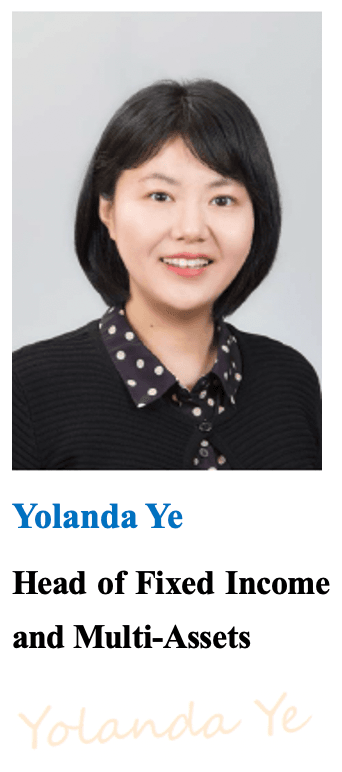
Yolanda Ye brings over 12 years of experience in fixed income investment and research to ZOAM Intl. in December 2020. Before this, she served as the Senior Fixed Income Portfolio Manager at China Life Franklin Asset Management, where she actively managed USD2.5 billion worth of assets. She had also worked with Guotai Junan Assets (Asia) as Fixed Income Portfolio Manager, responsible for private fixed income portfolio investment; with HSBC as Fixed Income Strategist; and with BOCI as Product Marketing (Fixed Income), Associate
Yolanda has taken home many international awards in her over-a-decade career. For three successive years since 2018, she was ranked respectively the 4th, 1st, and 9th “The Most Astute Investors in Asian G3 Bonds” by The Asset. In 2019, she was awarded “China Life Asset Management Co., Ltd. Golden Performance.” In 2020, she was honored “One-Year Golden Bull Overseas Private Fund Investor Manager (Fixed Income)” by China Securities Journal.
Yolanda obtained a BBA from the City University of Hong Kong under a full-ride scholarship, which she received after a freshman year at Fudan University. While working for BOCI, she earned a Master’s Degree in Finance from The Hong Kong University of Science and Technology.
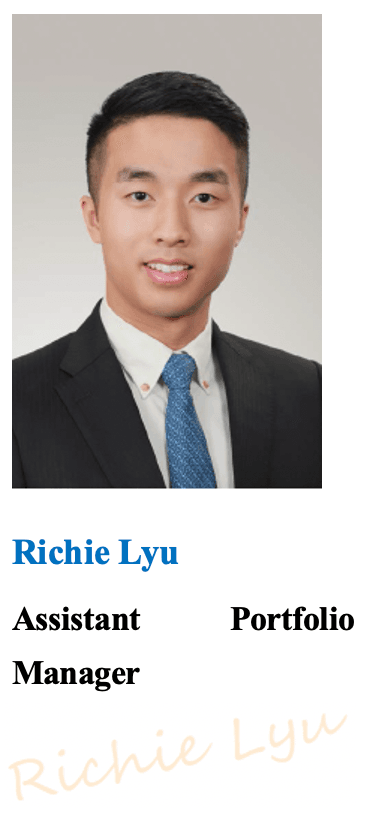
Richie Lyu has more than four years of experience in overseas bond investment. Before joining ZOAM Intl. in October 2020, he was a Fixed-Income Analyst at China Life Franklin Asset Management, responsible for analyzing Asian high-yield bonds and trading fund. Richie had also worked at Guotai Junan Assets (Asia) as Fixed Income Analyst, in charge of researching and analyzing Asian investment-grade bonds; and at the Bank of China (Hong Kong) as a bond trader of the Global Markets Department. He obtained a BBA in Accounting and Finance from The Chinese University of Hong Kong under a full-ride scholarship.
Q1: Yolanda, can you please talk about your research and investment style? And how do you and Richie cooperate after teaming up for such a long time?
Yolanda: We are happy to join ZOAM Intl. To be frank, my investment philosophy is plainly simple—just getting prepared for the worst, but trying the best. How I come to this idea? It’s mainly because of my former experience. I got to know the bond market from an issuance side, which gave me an opportunity to understand how investment banks manage to attract buyers by enhancing the image of an issuer while assisting in its bond issuance.
Back then, default rate was low in Hong Kong, even less than 1.5% for Chinese issuer USD bonds (i.e., USD-denominated bonds issued by Chinese financial institutions and companies). As long as we duly perform corporate research and customer communication, default risk was unlikely to materialize. But some of the projects I participated in did witness the rare cases of bankruptcy, which taught me a valuable lesson. I have since deepened my research to better avoid such risky companies and even to seek profitable opportunities.
Unlike equity investment, bond investment seldom generates bountiful returns, but may probably fail and cost all the principal. The possibility of loss is much greater than that of profit. Facing such investment features, my top priority is to preserve the investment value and ensure that the issuers will pay interest and return principal on time. Although this logic seems basic and simple, I believe only by a persistent dedication to the rudimentary work can we live up to the trust of our investors.
So, by saying “getting prepared for the worst, but trying the best,” I mean we should endeavor to identify growing companies and the most suitable bonds by evaluating the fundamentals and removing the obstacles. That explains why the funds under my management have stayed relatively stable even during market turmoil. For example, my products created positive returns for most of 2018, amid intensified market volatility caused by succeeding changes including the supply-side structural reform of China and the monetary policy transition of the U.S. In March 2020, in spite of a similar liquidity pressure, my prior experience had prepared me to take action early and select strong performers.
My story with Richie traces back to my fund manager days at Guotai Junan Assets (Asia). I was on maternity leave, and the company hired for me an analyst specialized in bonds issued in Mainland China. Though I wasn’t there at the interview, I was pretty satisfied with his experience in trading Mainland bonds. Since I left the Mainland at 18 for college, I had dealt only with overseas bonds, such as overseas high-yield bonds and Chinese issuer USD bonds in the real estate sector. Richie has cured my ignorance of LGFV bonds and other Mainland bonds. We have learned a lot from each other for the past three years, and he has indeed become my right-hand man. I am deeply honored he is willing to join ZOAM Intl. together with me.
Q2: You two research and invest both in Mainland bonds and overseas bonds, such as Chinese issuer USD bonds. Richie, can you talk about the major differences between your research on these two types of bonds?
Richie: In terms of fundamental analysis, Chinese issuer USD bonds differ slightly from Mainland bonds, because most of them are issued by the same Chinese companies. My Mainland colleagues have conducted in-depth fundamental research on most of these companies. So that we can mainly focus on the analysis on the different structure of the two markets. Generally, there are two types of bond market participants: one is investors, such as fund companies, banks, and securities brokers which are key buyers in the market, and the other is bond issuers.
The Mainland bond trading platforms include interbank market and exchange market. Investors of the former are mainly banks, while those of the latter are institutions such as brokers and funds. In either case, investors who hold bonds to maturity are the largest in number.
The overseas bond markets are mostly OTC markets open to all professional investors. This is also true for Chinese issuer USD bonds, which are invested chiefly by actively-managed funds or asset managers, followed by banks, insurers, or private banks serving high-net-worth individuals. Those investors, though primarily Asian, come from the Europe and U.S. as well, with a share of 20%.
Compared to the Mainland market, the overseas market opens to investors of all types and regions, who have much diverse background and tend to trade in different directions. The overseas market is therefore more liquid. For example, in March 2020, many European and American investors sold Chinese issuer USD bonds due to overseas risks, while Chinese investors treated this as a great opportunity to buy low. This is one sign of higher liquidity. In contrast, the Mainland bond market is dominated by Chinese institutional investors that tend to share similar interpretations of new policies and similar responses to market changes. That results in a one-sided market and greatly restricts liquidity.
When it comes to analyzing Chinese issuer USD bonds, in addition to fundamentals that Mainland investors care about, we also look into two factors: the issuance structure and issuer rating.
First, issuance structure. A Mainland company can issue bonds directly in the Mainland with simpler covenants. But overseas issuance is complex under tax laws and regulatory requirements. Common structures include: (1) direct issuance; (2) issuance by an overseas SPV (Special Purpose Vehicle) under the guarantee of the Mainland company; and (3) issuance by an overseas SPV under a keepwell deed or other arrangements with the Mainland company. Issuance structures of Chinese issuer USD bonds are one focus of our research. As to issuance terms, common covenants of overseas USD bonds include: (1) change in control; (2) cross default; (3) percentage restrictions on new debt; and (4) restrictions on sale or transfer of assets/equity in subsidiaries. Such covenants provide better investor protection than those of Mainland bonds. As an investment manager and an analyst, we need to gain some insight into these covenants.
Second, issuer rating. The credit rating system in Mainland China is less sophisticated comparing to international standards. Most bonds are rated AAA, AA+, and AA. A rating of AA- or below represents higher risks. Investment agencies must resort to a strong internal rating system to support their research results. Contrarily, the overseas bond market adopts the international credit rating system, which covers 18 ratings from AAA to CCC. From this perspective, Chinese issuer USD bond market has a more granular classification of issuers’ credit standing, which helps investors to form a preliminary judgment. Such judgment, coupled with the credit analysis conducted by the research team, will enable investors to analyze a company more comprehensively. For this reason, international credit rating can be more helpful for investors of Chinese issuer USD bonds.
Q3: When buying overseas bonds, investors are concerned about nothing but how to effectively control foreign exchange risk, liquidity risk, and default risk. Yolanda, can you talk about your investment research from the perspective of risk control?
Yolanda: For bonds issued by Chinese companies, our research naturally relies on the strong research team of our parent company, which gives us deeper insight into corporate quality. For bonds issued by other companies, our research focuses particularly on government bonds from European countries and the U.S., preferred stocks from European banks, and bonds from foreign giants, like Boeing. These bonds have high quality, greater transparency, and most importantly, low default risk and high liquidity.
The remaining foreign exchange risk can be hedged by derivatives. Anyhow, the final investments depend on our clients’ needs, which are the ultimate guidance in our pursuit of differentiated return. If a company shows high credit quality, price movements, good liquidity, and greater return, we will always identify the proper investment opportunity, instead of taking great risks for high returns in the short term.
Q4: Yolanda, can you talk about the benefits of buying overseas bonds from the perspective of asset allocation? And what are your recommendations for clients new to the overseas market?
Yolanda: Generally, experienced overseas investors will invest 50% of their funds in Chinese issuer USD bonds and the other 50% in other overseas bonds, to pursue higher return while diversifying risks. However, we have noticed that when market is highly liquid, many Chinese investors tend to chase after Chinese issuer USD bonds and accordingly press down returns; and flock to sell the bonds when relevant Mainland policies tighten, drastically fluctuating the return of a bond portfolio.
Therefore, we recommend purchasing non-Chinese issued bonds as a way of diversification to reduce fluctuation. We believe a reasonable diversification has positive effects on investment portfolios, as evident in 2020 when the global macroeconomy was challenged by the COVID-19 pandemic and changing geopolitics. Diversification will also help avoid excessive concentration in the real estate sector which has the most issuers of Chinese issuer USD bonds.
We also pay close attention to assets issued by Chinese banks and foreign banks. Preferred stocks issued by Chinese banks yield about 3% to 3.5% while preferred stocks or perpetual bonds issued by European banks yield about 5% to 6%. Both are profitable assets. Though European bonds is more volatile due to better liquidity, it further underlines the value of deep research, since only an investment team that understands the market and risk could grasp potential investment opportunities.
For investors new to the overseas market and lack confidence in foreign bonds, we suggest a portfolio with 80% of Chinese issuer USD bonds and 20% of foreign bonds that are internationally rated as investment-grade. Investors may adjust the portfolio after a couple of years when they get familiar with the overseas market.
Q5: Currently, the macro-environment remains unstable and the financial market is under the pressure of Sino-U.S. tension. What’s your opinion on the short-term trend and how does it impact your portfolio construction?
Yolanda: In the short run, Sino-U.S. relation will still be the top concern. Frankly, I doubt whether the relation will improve under the president-elect Joe Biden. Keeping it from deteriorating will be a good result. Against this background, active management is a better choice than holding to maturity, because the market keeps moving up and down and a correct prediction on the trend promises handsome return.
We will be more prudent in regard to Mainland companies that rely heavily on overseas issuance. But almost all the real estate issuers who come from the Mainland raise funds that can be sourced down to the Mainland. The investment environment is safe from the perspective of overall fundamentals. As for asset allocation, I still suggest diversification with some non-Chinese issued products to disperse the risk.
Q6: The last question: Yolanda and Richie, can you talk about our competitive advantage over peers in the medium and long run? What are your long-term expectations for the Fixed Income and Multi-Assets Team?
Yolanda: I’m mostly attracted to ZOAM Intl.’s corporate culture—valuing long-term performance and the investment capability of fund managers. Unlike stocks, bonds can hardly deliver outstanding performance in just a short period. A fixed income strategy is therefore a test of long-term investment ability and patience.
From the perspective of asset allocation, an excellent fund manager must reach the objective of asset allocation—i.e., creating a stable return for the clients. It’s difficult but important to earn the trust of our clients, so I am not a big fan of short-term trading. Taking a long-term view, I certainly want to see our active management style win over investors and hence increasing our AUM.
In Hong Kong, many asset managers focus on “channel business” or non-standard financial products for an immediate increase of their AUM, ignoring active investment. I hope ZOAM Intl. sends a signal to the financial sector of this city that we manage to maintain a stable AUM through professional investment and value long-term performance. As a Chinese company, we aspire to sustainable development through an active management strategy.
Richie: I share the same expectations as Yolanda. In addition to corporate culture, the company’s efficient internal cooperation also interests me. In my opinion, what matters most for a fund or asset manager is the cooperation between the investment department and other supporting departments. The latter here include sales, product development, operations, and others. Only with their supports can we concentrate on investment research and continue to hone our professional skills.
The cohesion across ZOAM Intl. speaks for itself, and I believe such a cooperation mechanism is a dream for every researcher. As for my long-term expectations, just as Yolanda said, I hope we can become an asset manager recognized by the market for our active investment capacity and carry forward our culture of seeking long-term performance.
Disclaimer
This article is for reference only and does not constitute an offer, solicitation or invitation by Zhong Ou Asset Management International Limited(“ZOAM Intl.”) to deal in any fund, security or other investment product, nor does it constitute investment advice tailored to the circumstances of any particular person. The views and analysis contained herein reflect the independent personal judgment of the relevant analyst as of the date of publication, do not represent the position of ZOAM Intl., and may differ from the views of other departments, affiliates or personnel of ZOAM Intl.. Such views may be changed without notice. Investors should not rely solely on the content of this article to make any investment decision, and should, before making any investment decision, take into account their own financial situation, investment objectives and risk tolerance, and seek independent professional advice where necessary. Information referred to in this article is obtained from sources believed to be reliable, but ZOAM Intl. does not warrant its accuracy, completeness or timeliness.